
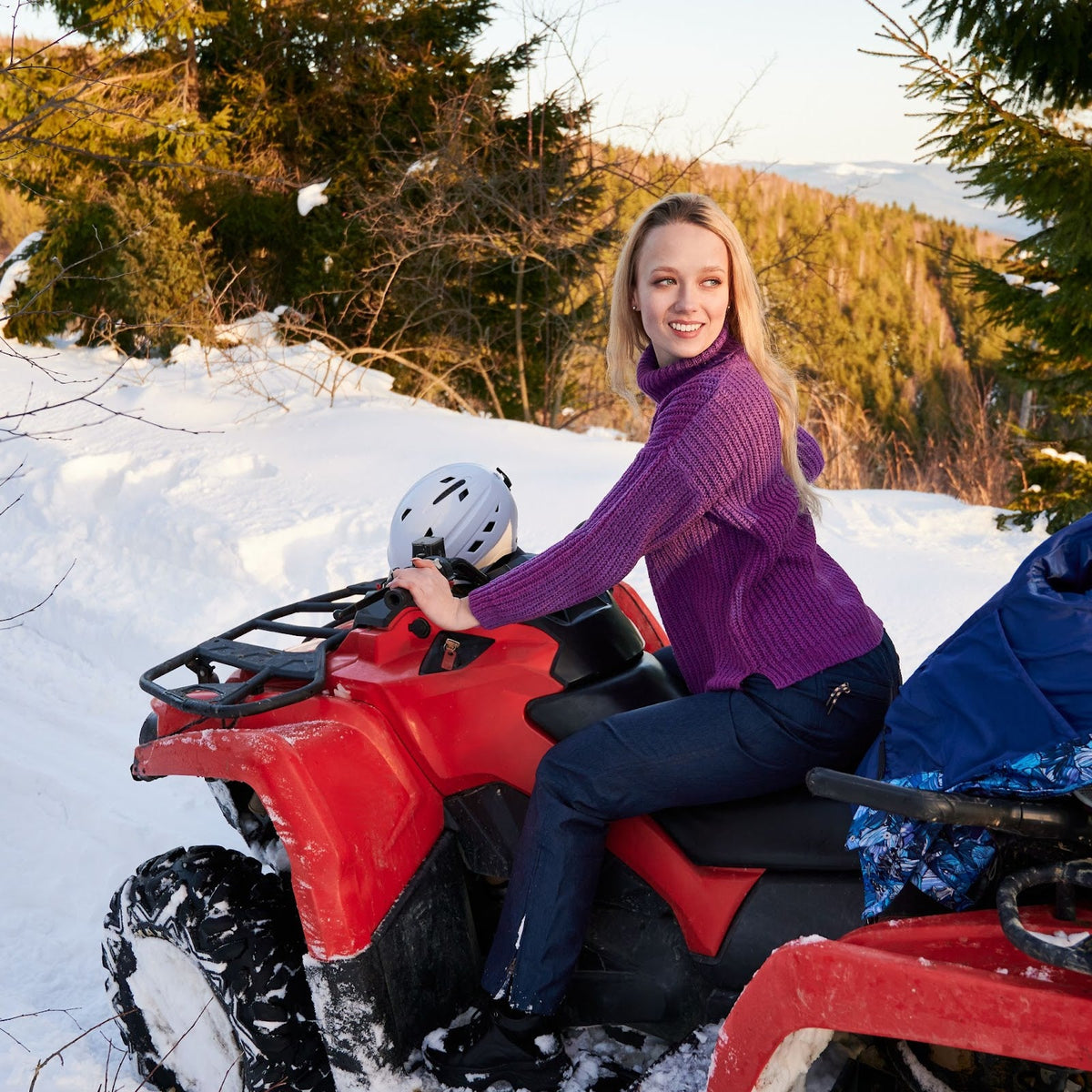
Summer gets the credit. But riding an ATV in snow is no off-season workaround, and plenty of riders across North America put more hours on their machine between November and March than they do in August. Snow riding is a season of its own, whether you run an ATV in the snow or a side by side.
Yes, you can ride an ATV in snow. The honest version of that answer has conditions attached. Cold changes how your machine starts, how your tires grip, and what the ground underneath you is actually made of. Winter conditions hide obstacles that summer leaves in plain sight. Snow and ice change the rules rather than cancel the ride.
At PERFEX Industries we build suspension, protection, lighting and recovery parts in our own North American factory, and every one of them gets tested through four full seasons before it ships. This guide covers what changes when the temperature drops, what to fit before you go, and how to come home with the machine intact.
Riding an ATV in Snow: Traction, Ice, and What Actually Changes
Snow does not behave like one surface. Fresh powder, wind-packed crust, slush over frozen ground and glare ice all sit under the same word, and each one asks something different from your tires. Traction is the variable that governs everything else in winter riding.
Icy patches catch experienced riders out. A trail that felt grippy at nine in the morning turns to a sheet by four, after a day of sun and refreeze. Hard-packed snow behaves almost like pavement until it does not. You can ride an ATV on ice, but only at speeds that feel absurdly slow until the first time you need to stop.
Cold changes the machine too. Battery capacity drops, engine oil thickens, and throttle response gets vague. Winter off-roading rewards riders who slow their inputs down. Gentle acceleration, steady throttle control and engine braking replace the quick inputs that work on dry trail, and a differential lock earns its keep the moment one wheel finds ice. Watch for wheelspin: it is the first sign you have run out of grip.
How Much Snow Can an ATV Handle?
In theory an ATV handles around two feet of snow. Reaching that depth takes modifications, and stock four-wheelers on an all-terrain tire struggle well before they get there. The modifications that matter fall into three groups:
- Traction modifications such as snow tires, snow chains or a track kit
- Power and drivetrain modifications, including 4WD use and low gear discipline
- Plowing and terrain modifications for riders working their machine rather than touring on it
Depth is only half the problem. Six inches of wet slush over a frozen rut stops a machine faster than a foot of dry powder, because deep snow that supports flotation beats shallow snow that grabs. Snow types decide the ride, not snow depth. Snowdrifts read shallow and run deep. Steep slopes turn into luck, and off-camber terrain tips machines that would shrug it off in July. Check trail conditions before you load up.
Setting Up a Four Wheeler in Snow: Snow Tires, Chains, or Tracks
Three setups cover almost every rider. Each one solves a different problem, and the right pick depends on the snow you actually have rather than the snow in the brochure. The same logic applies to a UTV in the snow, so SxS owners can read straight through.
Riders ask which is the best ATV for snow, or the best UTV for snow. Setup beats model: a well-equipped mid-size machine out-rides a bigger one.
Snow tires suit light to moderate conditions and mixed terrain. Snow chains add bite on icy trails for a fraction of the cost. A track kit converts the machine entirely, trading speed for flotation in deep snow.
A four wheeler in snow is only as good as its contact patch. Everything below starts there.
Snow Tires and Tire Pressure for Cold-Weather Traction
A generic all-terrain tire manages a dusting, not a winter. Snow tires want a deep, open tread that clears packed snow rather than holding it, a rubber compound that stays pliable below freezing, and enough width to float. Maxxis, High Lifter and Falcon Ridge mud tires work in a pinch because the directional tread throws snow outward. Fitting your ATV with snow tires each autumn takes an afternoon.
Tire pressure matters as much as the tire. Lowering pressure by roughly three to five PSI widens the contact patch and improves grip on soft surfaces. Cold air also drops your pressure on its own, so check it at the trailhead rather than in a heated garage.
Tire chains and traction aids such as traction boards cover the gap when winter tires are not enough. Keep a set in the rack.
Our ATV tire pressure guide covers the right PSI for snow alongside every other terrain.
Track Kits, Flotation, and Deep Snow
Track systems spread the machine's weight across a much larger footprint. That is flotation, and it is why a tracked Polaris RZR or Can-Am Outlander crosses deep snow that stops a wheeled machine cold. Tracks steer harder and run slower. They also cost far more than tires, and on hardpacked snow they are overkill. A machine that never gets bogged down does not need them.
Width changes behavior too. Wheel spacers push the wheels outward, widen the stance and lower the effective center of gravity, which helps on off-camber snow and side slopes. The trade-offs are real and worth reading about before you buy.
See ATV wheel spacers: pros and cons for the full picture.
Shop Aluminum Wheel Spacers Built for Winter Stability
Precision-machined aluminum, backed by a lifetime structural warranty. Pick your make and model and the fitment is handled.
What the Snow Hides: Skid Plates and A-Arm Guards
Most snow wheeling guides skip this part. Snow is opaque: the rocks, stumps, frozen ruts and fence posts you steer around in July are still there in January, and you cannot see one of them.
Hidden obstacles are the whole problem. Snow piles left by a plow hide curbs and culverts, and even marked trails bury their own edges.
Trail riders who damage machines in winter rarely do it spectacularly. They do it by hitting a hidden obstacle at moderate speed on a trail they have ridden fifty times. Skid plates turn that impact into a scrape.
Our guide on how to choose an ATV skid plate walks through coverage and material.
Undercarriage and CV Boot Damage Under Hard-Packed Snow
The undercarriage takes the worst of it. Engine cases, fuel lines, exhaust and the front differential all sit low, and hidden rocks under snow reach them easily. A full skid plate kit covers that span in one piece.
CV boots are the quieter failure. An ice crust forms as snow melts against a warm drivetrain and refreezes, and the sharp edge of that crust works at the rubber every time the suspension cycles. A split CV boot throws its grease, takes on water and salt, and the joint fails weeks later in the spring with no obvious cause.
A-arm guards and CV boot guard kits stop that before it starts. Shop A-arm and CV boot guard kits or browse every ATV skid plate we make. The cheapest repair is the one the snow never gets to start.
Suspension Lift Kits and Winter Ground Clearance
Ground clearance is the difference between riding over snow and bogging down in it. A stock Yamaha Grizzly, Polaris Sportsman or Polaris Ranger sits low enough that the frame starts plowing once the snow passes belly height, and once the frame plows, the tires stop driving. Utility machines such as the Can-Am Defender, Honda Pioneer, John Deere Gator and Kawasaki Teryx carry the same problem with more weight behind it.
A suspension lift kit of two to three inches buys that clearance back and makes room for taller snow tires at the same time. PERFEX lift kits are direct bolt-on per make and model, with installation manuals and a lifetime structural warranty on the structure itself.
Browse ATV suspension lift kits for your machine.
Plowing and Hauling: Putting a Quad on Snow to Work
Not every winter ride is recreation. A quad on snow clears a driveway far faster than a shovel, hauls firewood where a truck cannot reach, and runs feed to livestock when the lane drifts shut.
Plowing is the most common winter job and the one that asks the most of a machine. Weight, torque and traction decide how much snow you move before you start pushing yourself sideways instead of the snow.
Plows, Plow Blades, and Ballast Weight
A plow system mounts a plow blade to the front of the machine, set to a working depth before you start. Straight plows suit flat driveways. V-shaped plows cut heavier snowfall and throw it to both sides. Snow plows and snowplow blades share mounting hardware with a winch mount. Plan the front end once.
Three things govern how well a plow works:
- Machine weight, with roughly 400 to 800 pounds being the practical floor for an ATV
- Available torque in low gear, where 4WD, all-wheel drive and a steady pace beat horsepower
- Ballast weight over the rear axle to keep the drive wheels planted
Polaris and CFMoto machines in the mid-displacement range handle a blade comfortably. Start early and take shallow passes.
For the full method, read how to snow plow with a UTV or ATV.
LED Light Bars and Pod Lights for Short Winter Days
Daylight is what winter takes first. A ride starting at three finishes in the dark, and stock headlights were never built to light a snow-covered trail where every surface reflects differently.
An LED light bar throws usable light far enough ahead to read the trail at speed. Pod lights fill the near corners a bar misses. That matters when you are plowing in reverse or picking a line through trees. Keep the lenses clear of ice. Add reflective gear if you share designated routes or shared use trails with other traffic.
Comfort hardware earns its place on the same wiring job. Windshields block the worst of the wind, heated grips and throttle warmers keep your hands working, and UTV owners can fit a cab enclosure, cabin heaters or a cab heater for genuinely warm winter rides.
Shop ATV LED light bars with a five-year warranty.
Safety Tips for Quading in Snow
Winter ATV riding carries risks that summer riding does not. ATV winter riding shortens your margin for error, distances feel shorter than they are, and a breakdown that is an inconvenience in June becomes a problem at minus fifteen.
Winter gear is not optional. Start with a moisture-wicking base layer, add an insulating layer, and finish with a waterproof outer layer. A full-face helmet, goggles, a balaclava, waterproof gloves, a chest protector and insulated riding boots handle the rest. Watch for the early signs of frostbite and hypothermia, and tell someone your route before you leave.
Know Your ATV Before the Temperature Drops
Know your machine inside out. Before riding new terrain or unusual conditions, check the owner's manual for a clear picture of what the vehicle can do. Most ATVs have a minimum operating temperature, so find out what yours is first.
Riding below it? The manual explains how to modify the machine for colder conditions. An engine block heater, a battery tender and freeze-resistant fluid all lower that floor.
Check your antifreeze and coolant rating. Switch to a winter oil, a low-viscosity oil that still flows when the engine is cold, and keep a fuel stabilizer in the tank if the machine sits between rides. Clear packed snow off the radiator before every start. Winterizing takes one evening.
If the machine has been sitting, our guide on starting an ATV after it has sat idle covers the wake-up sequence.
Never Ride Alone on Snow-Covered Trails
In summer you can slip away for a solo ride to clear your head. In winter, do not. Snow-covered trails and frozen back roads make every vehicle harder to control, and getting stuck alone turns a two-minute recovery into an emergency.
The buddy system is the whole of it. Riding is social anyway, so find a riding partner and keep each other in sight. Carry an emergency kit, a first-aid kit, a shovel, communication devices and emergency equipment. Knowing how to get unstuck matters more than any single part you bolt on.
Riders heading out for ice-fishing face one more judgment call. Frozen surfaces need real ice thickness to carry a loaded machine, so check it rather than assume it. Check whether snowmobile trails in your area permit off-road vehicles, and yield when they do.
Planning something longer? Our list of the best ATV trails in the USA is a good place to start.
Get a Synthetic Winch Rope Before You Get Stuck
Lighter than steel cable and safer under load. A winch rope is the one part you will wish you had bought before the day you need it.
Four Wheeling in the Snow Without Wrecking Your Machine
Four wheeling in the snow is hard on equipment in ways summer riding is not. Salt, meltwater and road grit reach places that dry dust never does, and the damage shows up months later. Snowy terrain is abrasive in a way dry trail is not, and winter terrain stays wet for months.
A twenty-minute routine after each ride protects the machine through the whole riding season. Riders who skip it pay for it in spring, not in January, which is why winter rides so often get blamed for damage that storage actually caused.
Post-Ride Care After Winter Riding: Salt, Corrosion, Storage
Rinse the machine after every ride. Salt and brine cause corrosion on frames, fasteners, brake lines and electrical connections, and they keep working long after the snow has melted off. Dry the connections and moving parts rather than leaving them wet.
Then look it over. Pre-ride checks catch the same things: a split boot, a loose skid plate bolt, a chafed wire behind the light bar. Store the machine under cover in a dry space, and disconnect the battery if it will sit for more than a few weeks.
Winter riding does not wear machines out. Winter neglect does.
Build Your Winter ATV Setup with PERFEX Industries
Bolt-on parts for Arctic Cat, Can-Am, CFMoto, Honda, Kawasaki, Polaris, Segway, Suzuki and Yamaha. Free shipping on US orders over $200, duties and tariffs covered.
Share:
ATV Wheel Alignment: How to Align Your Front Wheels
Best ATV for Farm Work: 5 Machines That Earn Their Keep